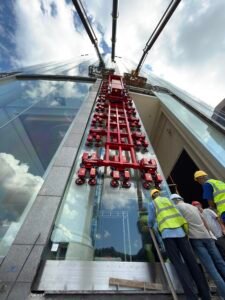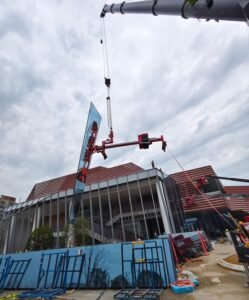
Curved Glass and Bent Glass Panels: Specialized Vacuum Solutions (And How Not to Drop a $10,000 Pane)
Let’s be honest for a second. Flat glass? That’s easy mode. You slap a standard suction cup on a flat sheet of float glass, pull a vacuum, and boom—you’re lifting. It’s predictable. It’s linear. It’s boring.
But curved glass? Bent glass? Architectural cylinders? That, my friends, is where physics likes to remind us who is boss.
Whether you’re installing a sweeping, double-curved storefront on a luxury high-rise or maneuvering a massive panoramic windshield onto a yacht, lifting curved glass is a high-stakes game. One wrong calculation, one stiff suction cup, or a slightly misplaced lift point, and crrrack—you’ve just turned a custom-engineered, three-week-lead-time masterpiece into a very expensive pile of glittering recycling.
Let’s unpack how specialized vacuum solutions make the impossible curves possible, why standard lifters fail, and how to keep your stress levels (and your glass) in one piece.
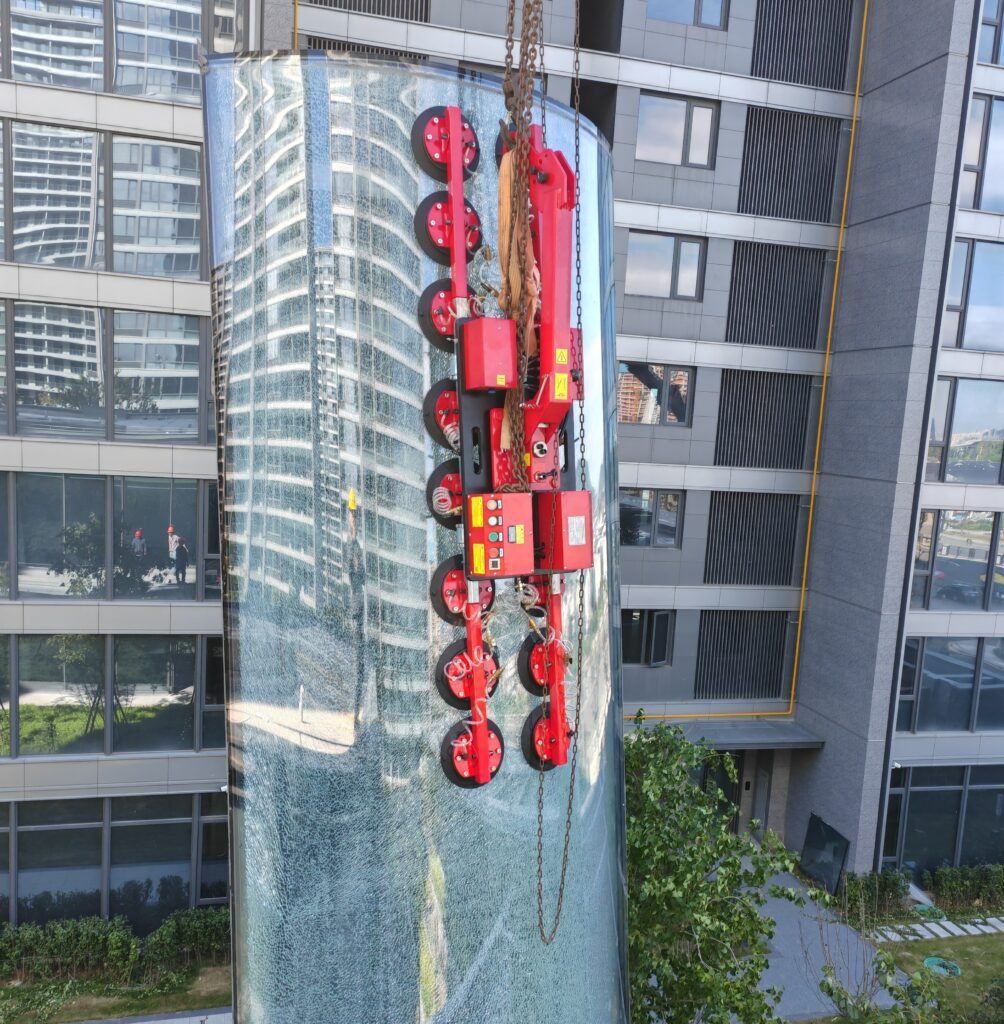
The Curve Conundrum: Why Flat Lifters Just Don’t Bend
Here is a quick breakdown of why curved glass defies standard lifting logic.
When you try to put a flat vacuum pad onto a curved surface, two bad things happen. First, the rigid metal or plastic backing of a standard pad cannot bend, meaning only the soft outer lip of the rubber seal actually touches the glass. This leaves a massive internal volume of air that your pump has to constantly evacuate, assuming it can even get a seal in the first place (spoiler: it usually can’t).
Second, the physics of the load distribution completely changes.
On a flat sheet, the lifting force is uniformly perpendicular. On a curved panel, the lifting forces resolve into complex vector components. You aren’t just dealing with a direct pull; you are dealing with shear forces trying to slide the cup along the curve.
Let’s look at the math. The actual holding force (FhFh) required on a curved surface must account for the angle (θθ) of the curve at the point of contact:
Fh=m×gn×cos(θ)×μFh=n×cos(θ)×μm×g
Where:
- mm is the mass of the glass.
- gg is gravity (9.81 m/s29.81 m/s2).
- nn is the number of pads.
- θθ is the angle of the glass surface relative to the lifting plane.
- μμ is the friction coefficient.
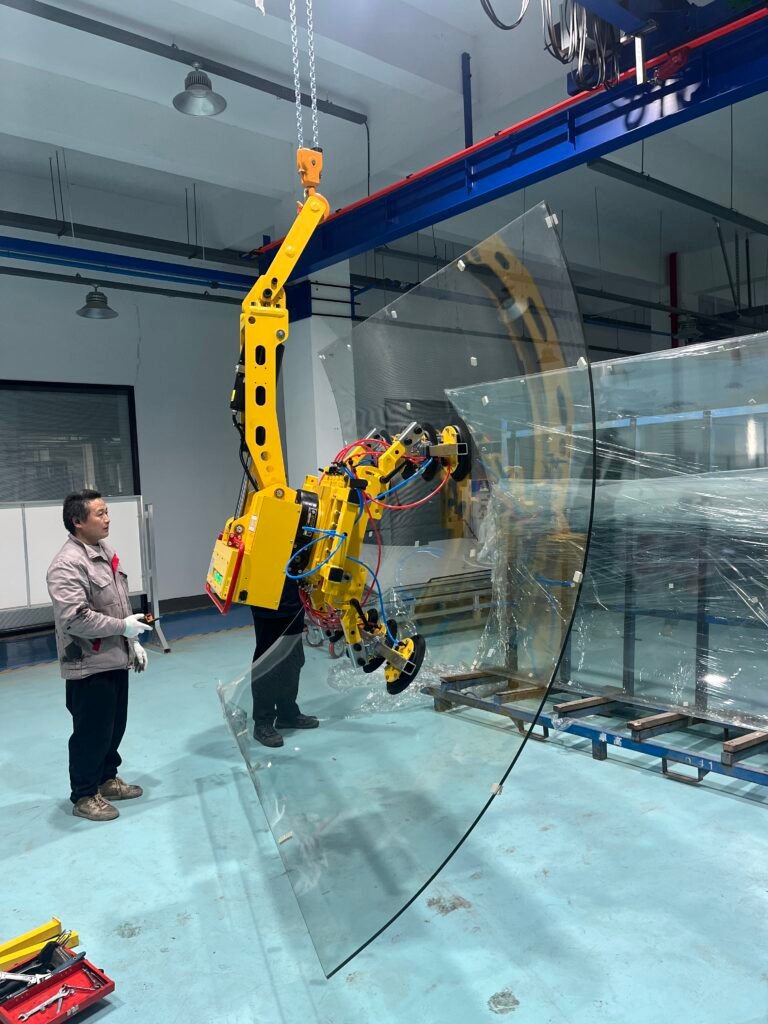
Anatomy of a Curved Glass Lifter: The Tech That Saves the Day
To safely handle bent glass, specialized vacuum lifters utilize three key engineering innovations.
1. Articulated Pad Mounts (The “Wobble” Joint)
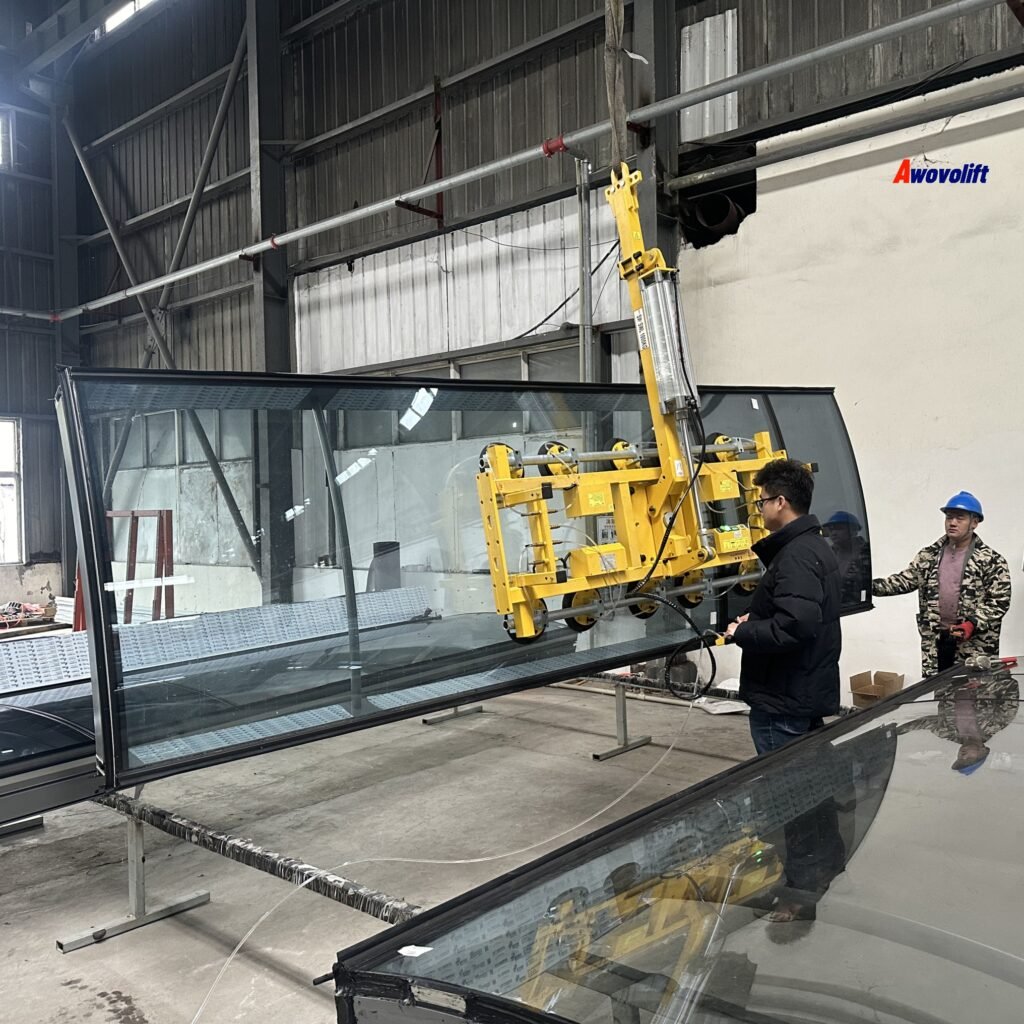
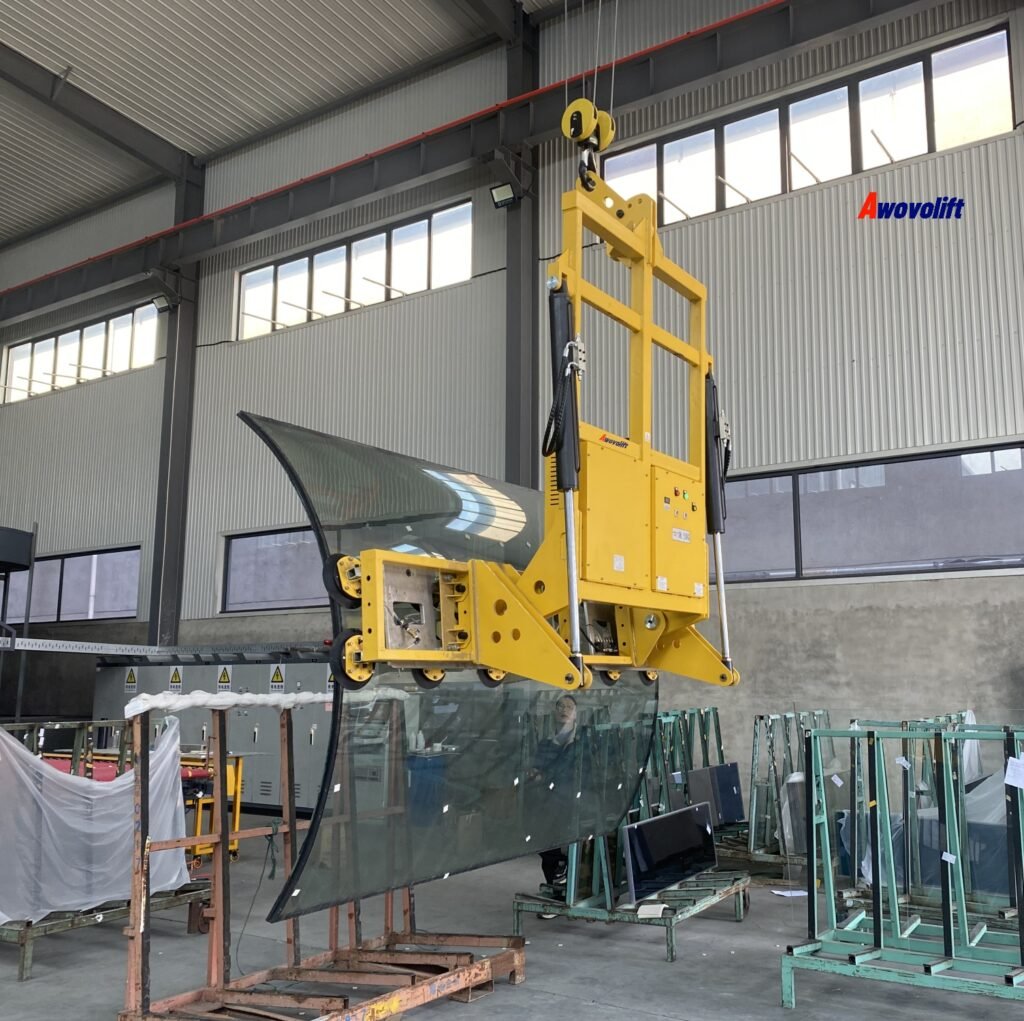
Instead of rigidly mounting the vacuum cups to the frame, specialized curved lifters use ball-and-socket joints or spring-loaded articulating arms. This allows each individual cup to tilt and rotate independently, automatically conforming to the local radius of the glass.
2. Deep-Dish or Concave/Convex Vacuum Pads
Standard pads are flat. Curved glass pads are engineered with a pre-curved, “deep-dish” profile or highly flexible, extra-long sealing lips.
- Concave pads are designed to grip the outer (convex) curve of the glass.
- Convex pads (often smaller and thicker) are designed to fit inside the inner (concave) curve.
- Dual-lip seals provide a secondary safety barrier, ensuring that if the outer edge loses contact due to a sudden shift in the glass radius, the inner lip maintains the vacuum boundary.
3. Modular, Adjustable Frames
Because no two curved panels have the exact same radius, the lifter frame itself must be highly adjustable. High-end curved lifters feature hydraulic or manual articulating arms that can be bent and locked into configuration to match the exact profile of the incoming glass.
❓ Q&A: Real-World Headaches & Curved Solutions
We get a lot of frantic calls from the field when it comes to bent glass. Here are some of the most common questions, answered with a healthy dose of real-world experience.
Q: We are trying to lift a panel with a very tight radius (under 500mm). Our standard cups keep popping off. What gives?
A: Yeah, a 500mm radius is incredibly tight for standard cups. What’s happening is “spring-back.” When you force a flat cup to bend to a tight radius, the rubber elastomer wants to spring back to its original flat shape. This internal material tension is actually stronger than the vacuum force holding it down, causing the edges to peel away and lose seal.
For anything under a 1000 mm1000 mm (39 in39 in) radius, you absolutely must use specialized small-diameter concave cups (typically 6 to 10 inches6 to 10 inches in diameter) mounted on adjustable swivel arms. Don’t try to use massive 12-inch12-inch flat pads here; they will fail every single time.
Q: Can we use the same lifter for both the inside (concave) and outside (convex) of a bent glass dome?
A: Yes, but you have to reconfigure the pads. Lifting the outside (convex) curve is generally easier because the glass curves away from the frame, giving you more clearance.
Lifting the inside (concave) curve is trickier because the glass curves toward the frame. If your pad mounts aren’t deep enough, the metal frame of the lifter will crash into the edges of the glass before the cups can even make contact. You’ll need extension rods or deep-profile pad mounts to safely clear the glass edges.
Q: How do we calculate the safe lifting capacity when the glass thickness varies across the curve?
A: Great question, and a dangerous trap. Laminated curved glass often has slight thickness variations due to the bending process.
Always calculate your lifting capacity based on the minimum vacuum level achieved during a test fit, and use a safety factor of at least 4:14:1 (instead of the standard 2:12:1 used for flat glass). If your calculations show you are close to the limit, add more pads. It is always cheaper to buy two extra pads than to replace a custom laminated panel.
Quick Comparison: Flat vs. Curved Vacuum Systems
| Feature | Standard Flat Lifters | Specialized Curved Lifters |
| Pad Mounting | Rigid, fixed to frame | Articulated (ball joints / springs) |
| Pad Profile | Flat, shallow lip | Deep-dish, flexible dual-lip |
| Minimum Radius | Typically >3000 mm>3000 mm | Down to 300 mm300 mm (with specialized cups) |
| Frame Flexibility | Fixed or manual extensions | Multi-axis hydraulic or manual articulation |
| Recommended Safety Factor | 2:12:1 (Horizontal) | 4:14:1 minimum (due to complex shear forces) |
Pro-Tips for a Flawless Curved Lift
Before you rig up your next bent glass panel, keep these three rules of thumb in mind:
- Do a dry run on the ground: Never attempt to lift a curved panel off the delivery truck without test-fitting the lifter configuration on a template or a safe, low-altitude test piece first. Adjust your swivel joints and lock them down before the real lift begins.
- Watch the temperature: Bent glass is highly sensitive to thermal stress. If the glass has been sitting in the sun, the curve can actually warp slightly, changing the radius. Let the glass cool down to ambient temperature before attempting a critical lift.
- Cleanliness is next to godliness: Because curved lifts rely so heavily on friction to combat shear forces, even a tiny amount of glass dust or moisture can cause a catastrophic slide. Wipe down every pad and contact point with a fast-evaporating glass cleaner before every single lift.
Curved glass is the crown jewel of modern architecture—but it demands respect. By investing in the right articulated vacuum technology and understanding the unique physics of the curve, you can make these complex lifts look as easy as lifting a standard flat pane.
The Curvature Problem: Radius Matters More Than You Think
Here’s where I get nerdy for a second. Curved glass curvature isn’t just “bent or not bent.” The radius of curvature (R) determines everything.
Research from HaanGlas shows that vacuum insulating glass can handle R ≥ 3000 mm (that’s about 118 inches) with controlled molding at 400 ± 20°C. But when you drop below R = 2000 mm, simulation data shows 78% probability that local support columns exceed the 300 kPa design limit. Translation: the glass stresses unevenly, and your vacuum lifter has to compensate for deformation that flat-lifting math simply don’t cover.
For curved glass installation, the rule of thumb I teach my crew: if the radius is tighter than 2 meters, you need a lifter with individually articulated pads, not just a frame with fixed angles. The Atlas Pro 400-600 Curved from Glass Handling Holland is designed exactly for this — 400 kg capacity on bent panels with independent pad rotation. One pad might be at 12 degrees, another at 18 degrees, and the frame don’t care because each pad articulates separately.
Cost-wise, curved glass processing fees eat 58% of the total cost structure, compared to just 22% for flat vacuum double glazing. A flat vacuum unit runs about €100 per square meter. Curve it to R ≥ 3000 mm, and you’re at €260 per square meter. Payback period stretches from 5.2 years to 9.8 years. So when you’re handling €260/sqm glass, using a €300 hand cup instead of a proper €4,500 curved lifter is what I call “penny wise, hospital bill foolish.”
The Automotive Angle: Windshields Are a Different Beast
Car windshields are curved, laminated, and heavy. A typical sedan windshield is 3.5–4.5 square meters, weighs 25–35 kg, and has a compound curve (curves in two directions). You can’t just slap four flat cups on it and hope.
In 2019, a BMW plant in South Carolina had a line shutdown because their flat-cup lifters kept losing vacuum on the new X7 windshields. The compound curve on those panels exceeded the compensation range of their standard equipment. They switched to a custom vacuum frame with concave pads and 6-axis articulation. Downtime dropped 73%. I don’t have the exact brand they used, but the principle is universal: curved glass demands curved solutions.
Automotive glass also has optical distortion zones. Place a suction cup over the driver’s sightline, and you’ve got a comeback warranty claim. Proper curved lifters use pad positioning that avoids the A-zone (the 200 mm radius around the driver’s focal point). It’s not just about holding the glass; it’s about holding it where it matters.
Q&A: Stuff We Get Asked at 6 AM
Q: Can I use flat cups on mildly curved glass? Like, R = 5000 mm?
A: Technically? Maybe. Smartly? No. At R = 5000 mm, a flat 8-inch cup will get about 70–75% seal contact. That’s a 25% force loss right off the bat. On a 300 kg panel, your safety factor drops below 2.5:1, which violates EN 13155 and ASME B30.20. I’ve seen it done. I’ve also seen the insurance claims.
Q: What’s the minimum radius for vacuum lifting?
A: Depends on your hardware. Hand cups with concave pads can go down to about R = 800 mm on small panels. Powered lifters with full articulation handle R = 1200–1500 mm routinely. Below R = 1000 mm, you’re in specialized territory — custom foam seals, perimeter frames, or adhesive vacuum systems. I personally don’t touch anything tighter than R = 800 mm unless the factory engineer signs off in writing.
Q: How do I know if my concave pads are worn out?
A: Look at the sealing lip. It should be smooth, slightly rounded, and free of nicks. If the lip is squared off or cracked — especially after summer heat exposure above 60°C — replace it. A worn concave pad on curved glass performs worse than a flat pad on flat glass. The seal geometry is everything. Most manufacturers say 6–12 months in heavy use, but I check mine monthly. Takes five minutes. Saves five figures.
Q: Can curved glass be lifted from the edge instead of the face?
A: Sure, edge-gripping clamps exist. But curved glass edges are often ground to a pencil profile or arris, which reduces the clamp contact area. For large architectural panels, face vacuum is still the standard because it distributes load across the structural sweet spot. Edge clamps concentrate stress. On a 6-meter curved facade panel, that concentration is where cracks start. I’ve got photos. You don’t want to see them.
Q: Do I need different vacuum levels for curved versus flat glass?
A: The vacuum level itself — typically 60–80% of full vacuum — stays the same. What changes is the effective vacuum because of seal leakage. On a flat panel, you might hold 85% efficiency. On a tight curve with marginal pads, that drops to 50–60%. So you need a pump with higher flow rate to compensate for the leak, not necessarily higher ultimate vacuum. A 12V DC pump with 20 L/min flow is the minimum I’d spec for curved work. Anything less, and the gauge will lie to you while the glass plots its escape.
Q: What about double-curved glass, like a dome or sphere section?
A: Double curvature is the final boss. Each suction point sees a different local radius. You need at least four independent, articulated pads with concave seals and individual vacuum monitoring. The PRT-DC3S I mentioned earlier handles this with a distributed vacuum system — each pad has its own circuit. If one pad loses seal, the others hold. On a spherical panel, that’s not a luxury; it’s survival.
The Bottom Line
Curved glass isn’t a flat panel that somebody sat on. It’s a different material with different stress profiles, different sealing geometry, and different handling physics. The market is growing at 8% per year because architects and car designers are obsessed with the look, but the installation side is still catching up.
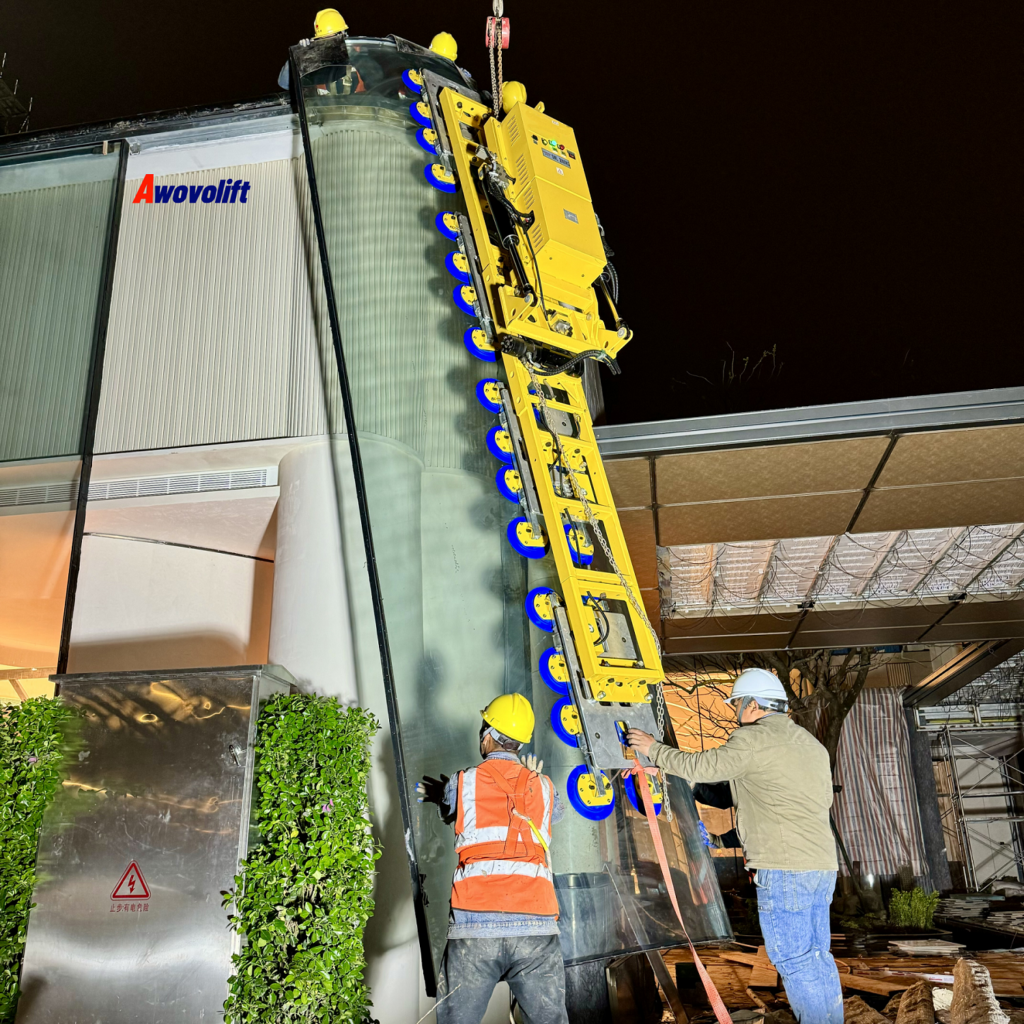
If you have any questions about the work according to the curved glass installation, you can contact us-AWOVOLIFT, and we provide professional solutions, including the curved glass installation project with the glass length within 20 meters length and the load within the range of 500kg-10tons.
Equipment operation ranges from manual tilting and rotation to glass installation equipment controlled by remote controller for hydraulic tilting and rotation.