Installing Glass on Super-High Floors and Super-Large Roofs: Why Height and Negative Angle Are the Real Enemies
The first time I stood on a swing stage at the 47th floor and looked down, my legs shook.
It was 2016. We were hoisting a 4.2 m × 2.1 m double-silver Low-E IGU weighing close to 1.8 tonnes. Wind poured in from the Huangpu River, and that piece of glass started spinning like a kite. The crane operator’s voice on the radio kept cutting out. That’s when I realized: this job isn’t about muscle. It’s about engineering.
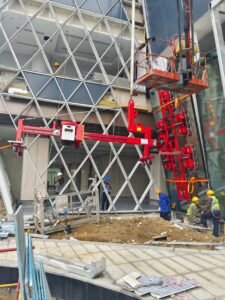
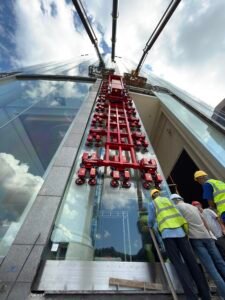
Since then, I’ve done too many of these projects — the terminal corridor skylights at Beijing Daxing Airport, the curved curtain wall of a supertall in Shenzhen, an inverted daylighting roof for an exhibition center in Chengdu. Each one taught me the same lesson: modern architecture wants bigger glass and cleaner façades, but the laws of physics don’t care about your renderings. Wind is still wind. Gravity is still gravity. Only now they meet 300 meters in the air.
Glass installation stopped being “carry it up and clip it in” a long time ago. It’s a real engineering problem: you need to calculate the lift path, select the right equipment, control the micro-environment, and make sure that half-tonne pane doesn’t shatter into snowflakes in front of your eyes.
This article is me emptying out the tuition fees I’ve paid over the years. No fluff. Just how we think on-site, how we messed up, and how we fixed it.
Height + Negative Angle: How the Hardest Combo Is Born
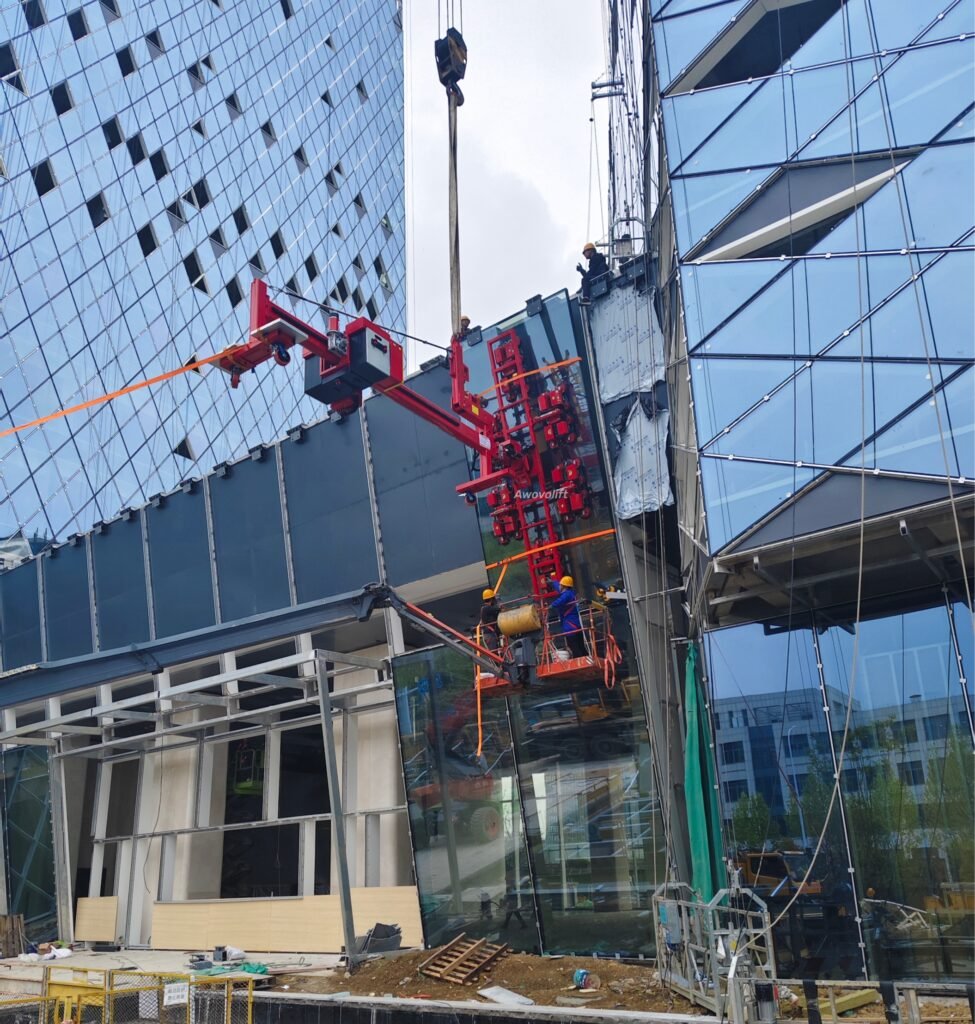
Wind Is the Invisible Enemy
Most people assume the biggest problem with high-rise hoisting is weight. Wrong. Weight you can calculate. The crane can be sized for it. What keeps you awake at night is wind.
Here’s a number for reference: at ground level, a “breezy” Level 3 wind (3.4–5.4 m/s) feels pleasant. But at 100 meters and above, due to the wind pressure gradient, the actual force acting on the glass surface can double. And wind isn’t constant — it comes in gusts, cycles of a few seconds to a dozen seconds. A 3 m × 6 m pane has 18 square meters of exposure. Even at 5 m/s, the lateral force is enough to visibly deflect the load.
In 2019, we learned this the hard way on a project in Guangzhou. Ground wind speed measured 4 m/s — well within safety limits. But when the glass hit 80 meters, it started swinging violently. We checked the data later: actual wind speed at that altitude was close to 8 m/s. The glass clipped an already-installed mullion, chipping the edge. That pane was scrapped — direct loss of over 150,000 RMB, plus three days of delay. Three days of the entire crew standing around staring at each other.
Since then, our on-site rule is: you don’t measure wind only at ground level. For high-rise hoisting, you need two anemometers — one on the ground, one near the lift height. If you can’t install one upstairs, you play conservative: ground wind above Level 3, high-altitude work stops.
Another rarely-mentioned problem: line-of-sight breakdown. The crane operator is on the ground. The installation crew is in a gondola or on the slab. Between them is a hundred meters of air. Once the glass is airborne, they can’t see each other. “Move left a bit” — the crane’s left, or the worker’s left? The glass’s left, or the frame’s left? Under pressure, these mix-ups happen constantly.
Our current protocol: every crew gets a dedicated signal person, using standard hand signals plus radio double-confirmation. And the signal person’s position is calculated in advance — they need to see the hook, the glass, and the installation point simultaneously. Sounds like common sense, but on-site, many contractors skip this role to save labor. You can’t skip it.
Negative Angle: When Gravity Stops Helping You
Roof installation, especially inverted or sloped daylighting roofs, is the most counter-intuitive work I’ve seen.
Normally, when you push glass against the frame, gravity helps you — the pane naturally settles downward, tight against the structure. But with negative-angle installation, gravity is your enemy. The moment the glass leaves the lifter’s support, it wants to fall away from the structure. You’re relying on temporary fixings or manual pressure to hold it in place until permanent mechanical anchoring is done.
In 2018, we had a project in Chengdu — an exhibition center with a wavy daylighting roof, slopes ranging from 15 to 45 degrees. The largest pane was 4.5 m × 2.2 m, to be installed on a 30-degree downward incline. We were using a standard vacuum lifter, brought the glass up vertically, but at the installation point we couldn’t angle it. The glass needed to transition from horizontal to inclined while staying flush against the purlins.
How did we solve it? We rigged a temporary scaffolding platform, four guys with manual chain hoists adjusting inch by inch. That single pane took nearly two hours. Four men, nerves stretched wire-tight the entire time. Afterward, the foreman told me: “Next time you want me to do this, either pay me more or get me better equipment.”
After that incident, we made it a rule for all sloped or inverted projects: you must use a lifter with powered tilt and rotation. Manual adjustment is unacceptable for negative-angle work — too risky, too slow.
Large Glass: Not Just Small Problems, Scaled Up
There’s an industry trend — glass keeps getting bigger, frames keep getting thinner. Architects want “invisible structure,” but the pressure all lands on the installation side.
A 2 m × 3 m pane and a 3 m × 6 m pane aren’t just double the area. Bending stress grows quadratically, even cubically. Large glass under uneven support during hoisting generates bending moments that can crack it mid-air. And more suction cups means vacuum system synchronization becomes critical — if one cup loses seal, load redistributes instantly, and the remaining cups may overload in a split second.
On a Beijing project, we handled a 3.2 m × 8 m laminated pane weighing close to 3 tonnes. The lifter had 16 suction cups across four independent vacuum circuits. Even so, the manufacturer required three no-load test hoists, confirming vacuum decay rates for each circuit were within safe limits before authorizing the actual lift.
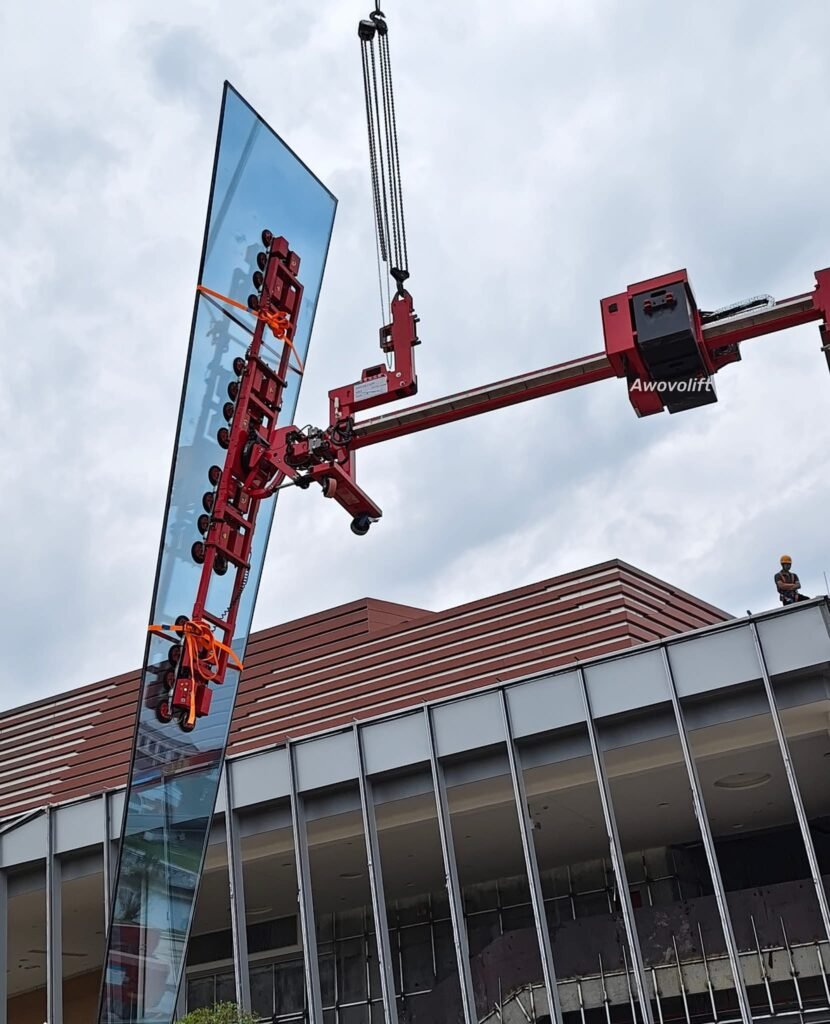
Sweat and Blood on Site: Lessons from the Field
Glass Breaks, But Rarely Because the Glass Is Bad
Honestly, in over a decade in this business, I’ve seen glass break due to quality issues during hoisting maybe three times. The vast majority of breakages come from improper handling.
The classic mistake: asymmetric suction cup placement. Picture a rectangular pane, four cups arranged in a line down the middle. Looks stable. But when the glass lifts, the center takes the load, both edges sag, and bending stress skyrockets. Especially with IGUs — two lites separated by a spacer, edge sealant has limited stiffness. Bend it too far, and the outer lite cracks from the edge inward.
Another time, the crane’s pick point was off-center. The glass tilted as it left the ground. One corner hit material stacked on the deck, and the entire pane shattered radially from that corner. Nobody was hurt, but glass fragments sprayed a worker’s hard hat — a loud clang. We still talk about it: that helmet saved his life.
Vacuum Loss: The Quiet Nightmare
Vacuum system failures rarely give you warning. They don’t snap like a wire rope with a loud crack. They fail slowly, quietly.
In 2021, on a Shenzhen project, we were using a secondhand vacuum lifter. The suction seals were aging, but visually they looked fine — no visible cracks, so nobody cared. Mid-hoist, one cup started leaking slowly, vacuum gauge needle drifting downward. Luckily, that unit had dual-circuit vacuum plus audible-visual alarms. The alarm sounded while the glass was still two meters off the ground. We brought it down, inspected, and found micro-cracks in three cup seals.
If there had been no alarm? I don’t want to think about it. The glass was passing directly above a temporary construction walkway. Workers were walking underneath.
That incident taught me: suction cup seals are consumables. Inspect them before every shift, replace them on schedule. Don’t save money here.
Swing: The Precision Killer
Once a large pane starts swinging, stopping it without mechanical assistance is nearly impossible. Wind gusts, crane start-stop inertia, even rope elasticity — everything turns the glass into a pendulum.
The traditional method is tag lines, workers on the ground or slab pulling ropes to control direction. But super-high work often makes this impossible — the glass is outside the building envelope, out of reach. At that point, you’re relying on the crane’s micro-movement precision and the lifter’s inherent damping.
When we spec equipment now, we specifically look at swing damping characteristics. Good lifters are designed with intentional friction damping in the swivel joints — the glass won’t spin at the slightest touch. Few manufacturers list this parameter in their brochures, but talk to an experienced engineer and they’ll tell you it matters.
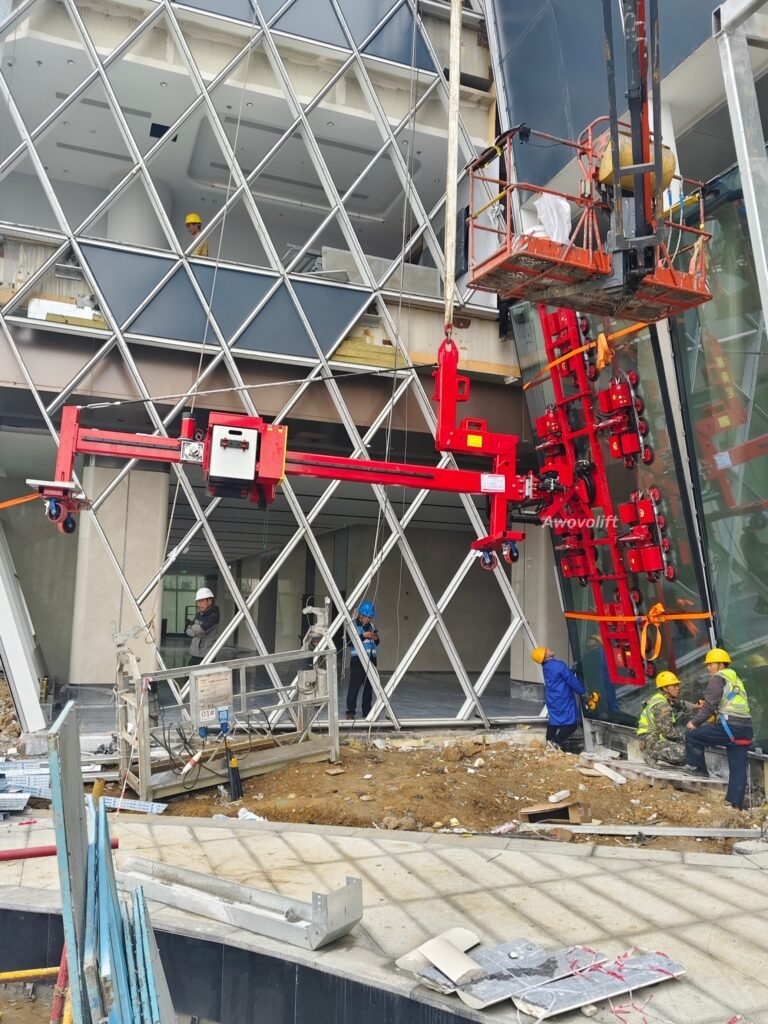
Before Hoisting: Solve Problems on Paper
My old boss used to say: “The site is for execution, not for thinking.” Every problem that should have been solved in the office costs ten times more to fix on-site.
Site Survey: Look Beyond the Drawings
When we get a project, our first step isn’t equipment selection — it’s visiting the site. What are we looking at?
- Crane positioning: Where can the crane stand? Is the swing radius sufficient? Can the ground bear the outrigger loads? Some project roofs are steel structures that can’t take heavy mobile cranes — you need to plan for roof cranes or tower cranes instead.
- Delivery path: Where does glass enter the site? How far is the unloading zone from the lift point? Any overhead power lines, temporary scaffolding, or other obstructions in between? I once saw a project where glass arrived but trucks couldn’t reach the crane. Forklifts had to transfer loads three times. Every transfer adds risk.
- Weather windows: Check historical meteorological data. Coastal cities often get sudden afternoon thunderstorms in summer, with gusts exceeding 10+. That means your work window is in the morning, or you avoid the rainy season entirely.
Lift Plan: Write It Down, Talk It Through
We require every project to produce a Hoisting Operation Instruction, including:
- Each pane’s ID, dimensions, weight, and installation location
Lifter model, cup count and layout
Pick point, lift path (3D diagram preferred), and set-down point
Personnel assignments and communication protocols
Emergency procedures: what if vacuum alarms? what if sudden wind?
This document isn’t paperwork. We hold a pre-shift briefing before every operation. Everyone signs to confirm they know what they’re doing today and where the hazards are. I’ve seen too many incidents that started with “I thought he knew.”
Environmental Controls: Don’t Fight the Wind
Our on-site iron rules:
Wind speed above 6 (≈10.8 m/s): hoisting stops.
Gusts above 8, even if average wind is low: stops.
Rain, snow, or fog with visibility under 200 meters: no work.
One small detail: glass surfaces and suction cups must be clean. Jobsite dust, oil stains, even morning dew affect vacuum sealing. We keep a cleaning kit on-site, with a dedicated person wiping glass and inspecting cups before each lift.
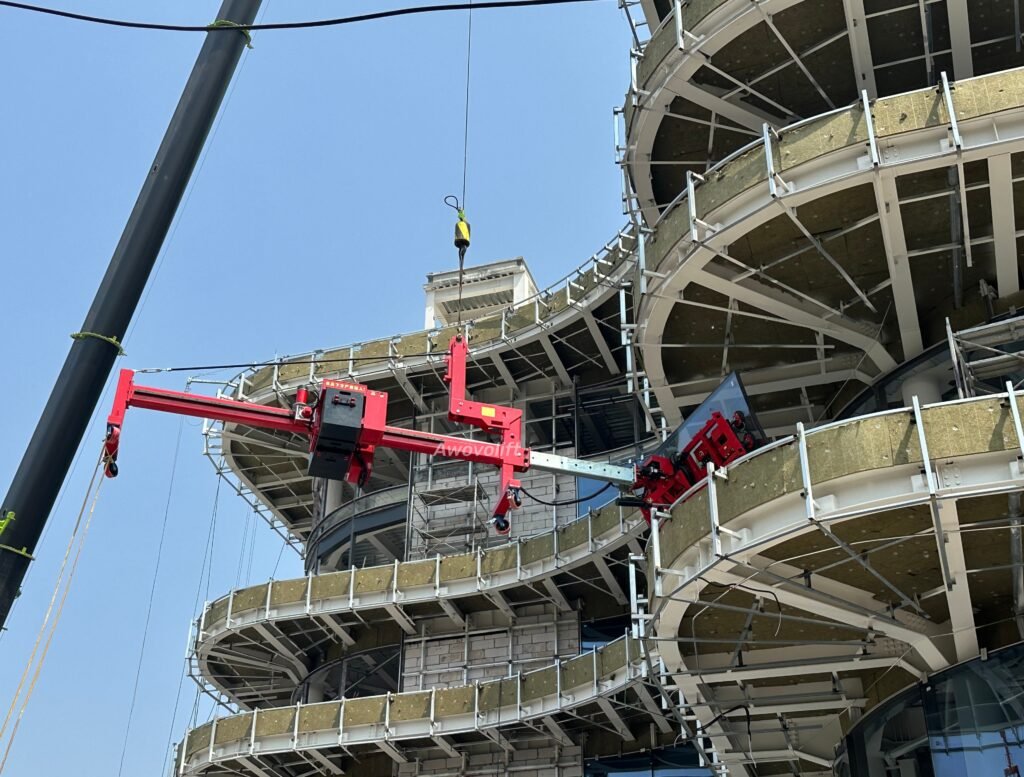
Equipment Selection: Don’t Just Look at Capacity
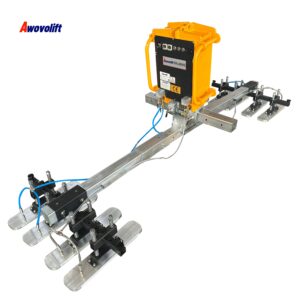
Many people selecting vacuum lifters open with: “What’s the maximum capacity?” That’s the starting point, but nowhere near enough. I use a five-dimensional selection method:
1. Weight: Leave Margin, But Not Too Much
The lifter’s rated capacity should exceed the heaviest pane by at least 20% safety margin. But margin isn’t “the more the better” — oversized equipment means more self-weight, larger dimensions, harder maneuvering in tight spaces. If your heaviest pane is 2 tonnes, a 2.5-tonne lifter makes sense. A 5-tonne unit might be too bulky to turn around.
2. Size: Cup Layout Matters More Than You Think
Large glass needs cups covering enough area to reduce local stress. Generally, cup edges shouldn’t be more than 300 mm from the glass edge, otherwise the edge lifts. Cup spacing should be even to avoid load concentration.
More importantly: frame stiffness. If the frame is too flexible, it sags in the middle under load, and the glass deforms with it. We typically ask manufacturers for maximum allowable deflection data, ensuring full-load frame deformation won’t put the glass into dangerous stress.
3. Angle: Can It Rotate, and How?
This is the most overlooked factor. Does your project require glass to rotate during hoisting? From horizontal to vertical, or from vertical to inclined? Do you need 360° rotation for orientation adjustment?
For simple vertical curtain walls, manual rotation might suffice. But for roofs, slopes, or complex nodes, powered tilt and rotation is almost mandatory. Manual control works on the ground. At height, workers don’t have the strength or the nerve to wrestle with hundreds of kilograms.
4. Height: Match the Equipment to the Crane
Super-high projects usually use tower cranes or large mobile cranes. Your lifter must interface with the crane hook system — shackle size, connection type, stability. Some projects operate above 100 meters with rope lengths exceeding 50 meters. In those cases, the lifter’s anti-rotation design matters. Otherwise the glass just spins endlessly in the air.
5. Precision: Millimeter-Level Demands
Modern curtain walls demand ever-tighter joint tolerances. Some high-performance façades specify 15 mm ± 2 mm sealant joints — meaning glass positioning accuracy must be within 5 mm. Relying on crane micro-movement for that? Almost impossible.
Good vacuum lifters should offer fine adjustment: forward/back/side-to-side micro-positioning, angle trimming, even powered push-assist for final seating. These features might rate a single line in the brochure, but on-site they can save you hours.
Safety Features: Baseline, Not Bonus
The following aren’t “options” to me — they’re mandatory:
Dual-circuit vacuum system: One circuit fails, the other holds.
Real-time vacuum monitoring + audible-visual alarms: Operator knows immediately if something’s wrong.
Battery backup: Power outage, vacuum holds for at least 15–20 minutes.
Load indicator: Prevents overload operation.
Why We Recommend Awovolift
I need to be straight with you: this article has a “sales” angle. But I’m selling from experience.
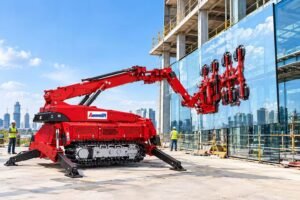
Over the years we’ve used vacuum lifters from European brands and domestic manufacturers. Awovolift’s product line currently has the highest coverage in our project database. Not because they’re the cheapest, but because their product segmentation is detailed enough to match the weird conditions we run into.
For example:
Manual tilt/rotate series: Good for standard vertical curtain walls, cost-effective.
Electric tilt/rotate series: Higher control precision, our go-to for most super-high projects.
Hydraulic tilt/rotate series: We use these for overweight glass and negative-angle work. Strong, stable movements.
Curved glass series: Curved panels hate localized stress. These dedicated lifters distribute load along the curve, avoiding stress concentration.
Their dual-circuit hydraulic vacuum system has given us serious confidence on heavy lifts above 3 tonnes. On a 2022 project, the equipment ran three months straight, hoisting over twenty large panes daily, without a single vacuum alarm. That kind of reliability, when deadlines are tight, matters more than saving a few thousand on equipment cost.
Of course, equipment selection isn’t about brand — it’s about fit. A good supplier sits down with you during pre-construction and figures out your concerns, instead of throwing a catalog at you and saying “pick one.” Awovolift’s engineers have joined us on-site several times. They understand what we’re worried about — that matters more than numbers on a spec sheet.
Final Words
Writing this, I kept seeing images: job sites at 5 a.m., frozen fingers in winter, that long exhale from the foreman when a pane finally seats into place.
This industry is hard. It’s dangerous. But when you stand at the foot of a completed building and look up at those flat, water-like glass panels reflecting sunlight — you know your craft is in there.
If you’re planning a supertall curtain wall project, or a complex roof glazing job, come talk to us. Not to buy something — to exchange experience. Tell me your site conditions, I’ll tell you where I’ve stepped in holes. Maybe together we can find the right solution.
Because glass doesn’t lie. Install it well or poorly — a few years of wind and rain, and the truth shows.
The author is a site engineering director with over a decade of experience in super-high-rise glass curtain wall installation. Case studies are based on actual project experience, with certain details adjusted for confidentiality.